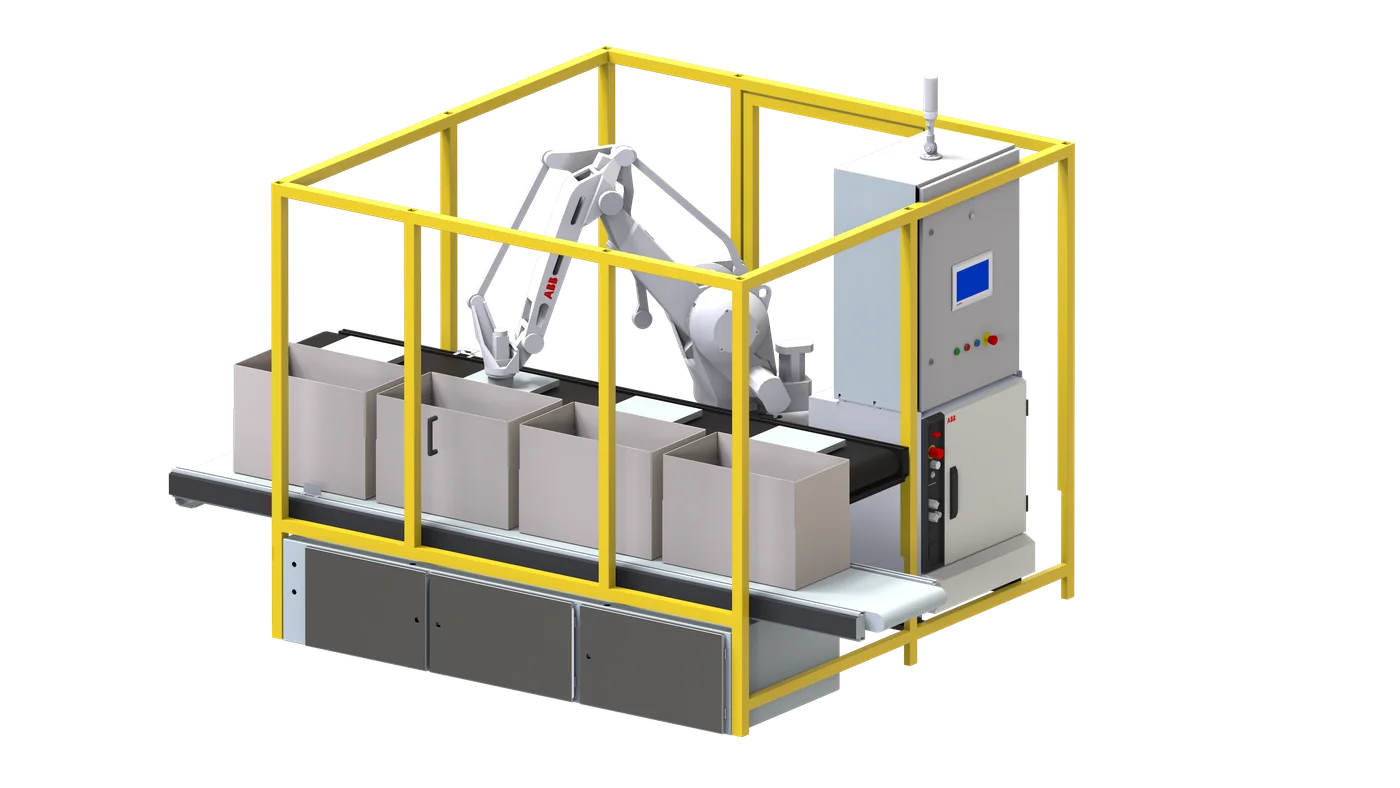
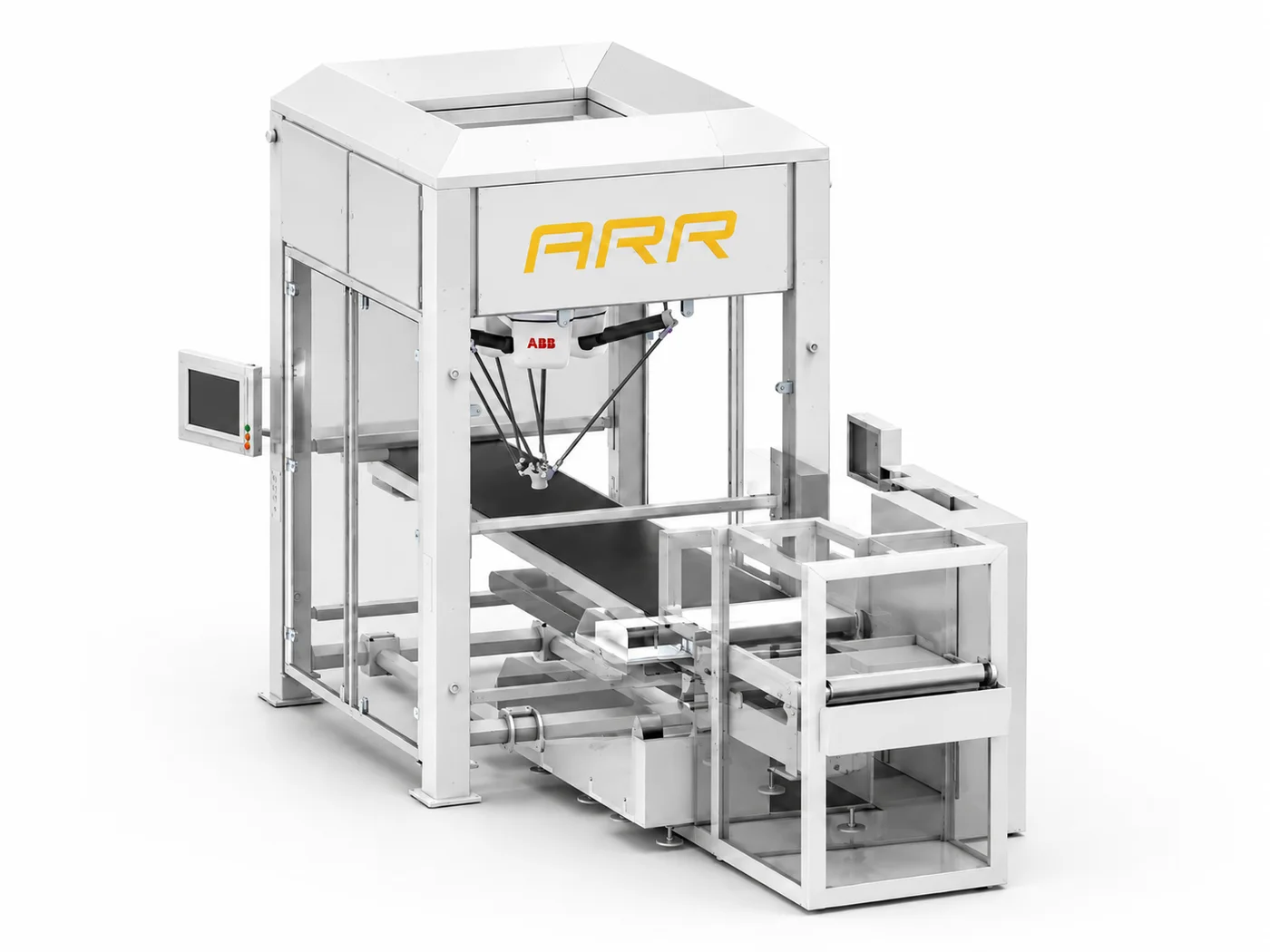
Case packing changes shape with the product and the case. Top-load, side-load or collate-and-load — the layout is chosen around how your product wants to be handled, not the other way around.
[A]TOP
Top-load cell
BEST FORRigid, uniform products into a held case
Product is lowered into an open case from above. The most common and gentlest layout — ideal for bottles, jars, cartons and trays that stack cleanly.
FORMATTOP-LOAD
CASE TYPESRSC / TRAY
OUTPUTAT LINE SPEED
HANDLINGGENTLE
CHANGEOVER< 30 MIN
[B]SIDE
Side-load / wrap-around
BEST FORBags, pouches and flexible packs
Product is loaded horizontally, or the case is formed around a collated stack. Suited to flexible or awkward packs that will not drop cleanly from above.
FORMATSIDE-LOAD / WRAP
CASE TYPESWRAP-AROUND
OUTPUTAT LINE SPEED
HANDLINGFLEXIBLE PACKS
CHANGEOVER< 30 MIN
[C]BULK
Collate-and-load
BEST FORHigh counts per case
Product accumulates into a full layer or pattern, then loads in a single motion — fewer robot cycles per case when counts are high, holding pace at speed.
The cell packs at upstream speed, shift after shift. Your team stops feeding cases by hand and starts running the line instead.
[02]
Format change in under 30 minutes
Carton, tray, top-load, side-load — adjustable across your range. ARR owns the programming; your operators own the changeover.
[03]
Wrong fit? Send it back
It runs unattended through standard shifts on one managed support path. If it doesn’t earn its rate on your line, it goes back.
(04)WHAT'S IN THE RATE — SPELLED OUT
Everything. Included.
One hourly rate covers the cell and everything that keeps it useful.
What's not included is spelled out too — see
what's included.
01INDUSTRIAL ROBOT ARM WITH PACKING END-EFFECTOR
02CASE SIZE PROGRAMMING
03LINE INTEGRATION AND PACING
04WEEKLY PERFORMANCE REVIEWS
05PREVENTIVE MAINTENANCE AND SPARE PARTS
06OPERATOR TRAINING
0724/7 BREAKDOWN RESPONSE
(05)DEPLOYMENT — FIRST CALL TO FIRST PALLET
Deployed in weeks.
No multi-month procurement cycle. From the first call to the first pallet
off your line is weeks, not months — and ARR carries the technical load the
whole way.
WK 0
[01]
Discovery
A 15-minute call to confirm the line & product requirements, and whether the rental structure is a good fit.
15 MINUTES
WK 1
[02]
Showcase & scope
We show our cells handling your product — not a demo reel — and hand you an indicative range.
PROOF FIRST
WK 2
[03]
Agreement
Scope, term and inclusions agreed in writing. What is in the rate is spelled out, and so is what is not.
IN WRITING
WK 3–6
[04]
Build & configure
We program the cell for your product, pallet pattern and changeover rhythm while your engineers stay on their own backlog.
YOUR PRODUCT
WK 7
[05]
Install & commission
Installed and commissioned in a day or two, integrated with your conveyor or line and run in against your product.
ON SITE
WK 8–12
[06]
Deployed & live
Operator training, then you hit start. The cell runs the shift and the savings begin the same week.
YOU HIT START
(06)STRAIGHT ANSWERS
Should we automate packing before palletising?+
Often, yes — especially when manual packing is the labour-hire pain. We scope the worst bottleneck first and recommend from there, not from a product catalogue.
How much of our engineering time will this take?+
Far less than a purchase. ARR handles programming, integration and coordination. Your team approves scope and runs the line.
Can we pilot it first?+
That’s what the 90-day pilot is for — prove it on your line, under $15k, before any longer commitment.